Why buyers and lenders both balk
Two things have to survive for a listed sale to close: the buyer's nerve and the buyer's lender. A failed cesspool takes out both at once.
The buyer is picturing the yard dug up and a bill nobody will commit to in advance. The lender is looking at a property that cannot practically be occupied until the waste system works. Either one alone is enough to end a contract, and the house goes back on the Bellmore market with more days on it and a cesspool in its history.
How we help Bellmore owners with a failed cesspool
We buy houses with failed cesspools regularly, which means we already know who does this work properly and roughly what it runs. That is the practical difference between us and a buyer meeting the problem for the first time.
We have sanitary contractors and engineers we have used for years, and we bring them in on our own account after closing rather than asking you to arrange anything. And if it turns out that replacing the cesspool and listing the house on the open market would leave you better off, we will tell you so and give you the name of the contractor we would call.
Why local knowledge changes the number
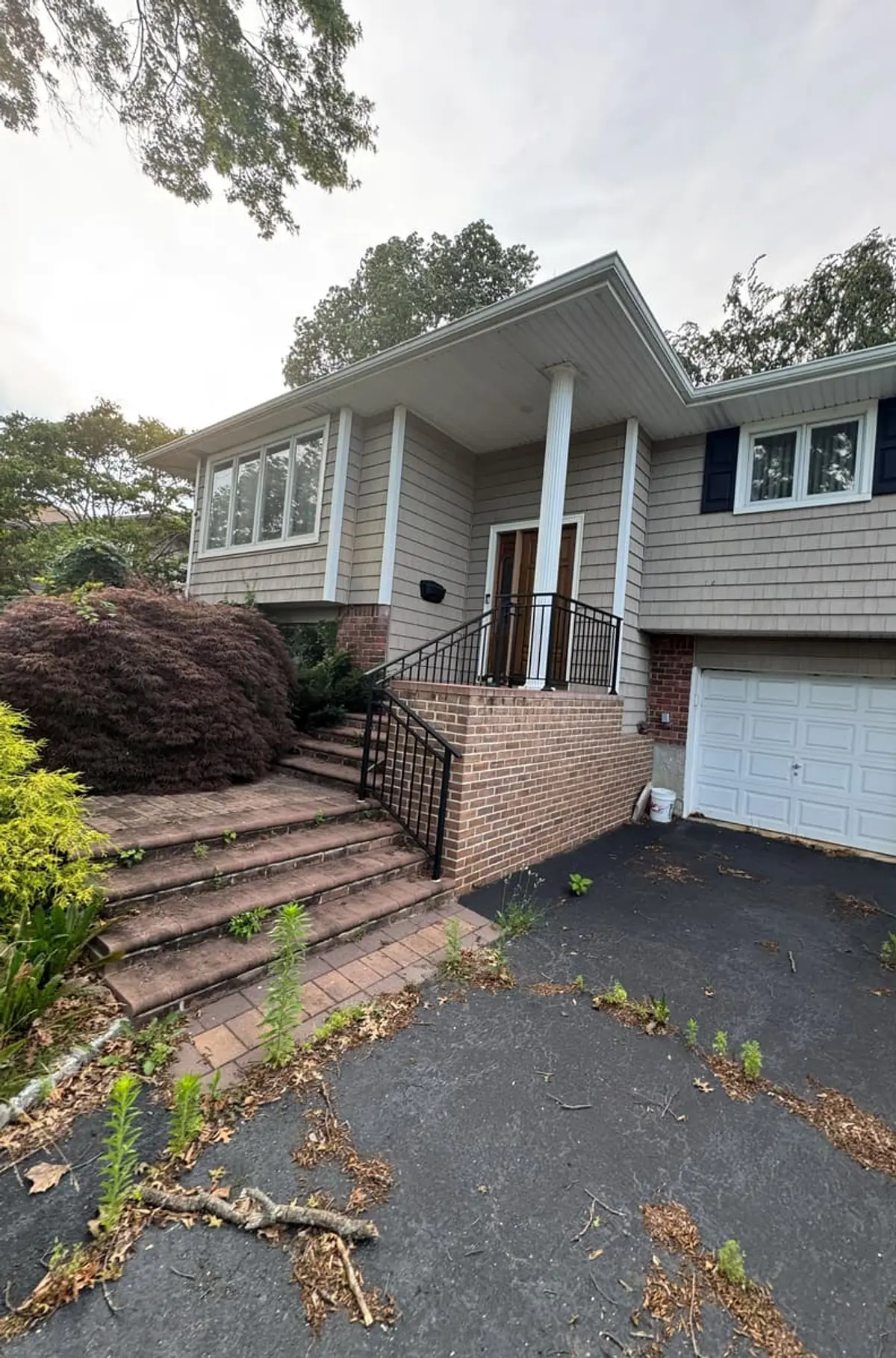
A house on Norman Drive. In Bellmore, bought and paid for by us.
Bellmore is roughly 16,297 people in Nassau County, ZIP 11710, and the housing stock is mostly hi-ranch, cape cod, colonial. Around Bellmore Avenue and Merrick Road, most of it is old enough that the mechanicals are on their second or third life. The Bellmore stop pulls buyers who commute, which supports the good houses and does very little for the ones that need a roof. We have been buying across Nassau County for 15+ years. We know what the Bellmore Union Free School District does to a resale price, which blocks still have oil tanks in the ground, and what a house like yours is actually worth here.
You do not need to replace it before you sell
There is a version of this where you borrow against the house, pay for a new system, and then find that the buyer who walked over the cesspool was not coming back and the next one wants something else fixed as well. We see it, and it is a hard thing to watch.
You do not have to repair the cesspool, pump it, inspect it or dig anything up to sell to us. The condition of the system is priced into the offer once, up front, and the offer does not move afterward.
The county health department, and why it matters here
Rules around waste systems on Long Island have changed over the years and continue to, and what applies at your address depends on the lot, the location and what is already in the ground.
The county health department is the authority on what a replacement cesspool or septic system at your address has to be, and a sanitary contractor will know what that means in practice. There are sometimes programs that help with the cost, which is worth asking about while you have them on the phone. If you would rather not run that errand at all, sell the house with the cesspool as it is and it stops being yours.
How we arrive at a number on a house with a failed cesspool
The honest answer on a house with a failed cesspool is that we work backwards from what it is worth once it is fixed, subtract what fixing it costs, and subtract what we need to make for the risk of being wrong about either. There is no secret to it and no algorithm.
- What it is worth repaired. Not the Bellmore median of $859,559 on its own, but what houses like yours on your street actually closed at recently.
- What the work costs. Roof, boiler, electric, the kitchen and bath. In Bellmore the stock is largely hi-ranch and cape cod, and on houses that age the mechanicals are usually the expensive part rather than the cosmetics.
- How long we will hold it. The median Bellmore house goes under contract in about 28 days once it is showable, then waits 45 to 60 days more on the buyer's lender. Ours has to get to showable first, and we carry taxes and insurance across the whole of it.
- What we are wrong about. Opening a wall finds things. That risk is priced in, which is a large part of why a cash number sits below a retail number.
Why the number works for us and not for you
This is the part most cash buyers are vague about, so here it is plainly. We run millions of dollars of construction a year. That volume buys materials at contractor pricing and keeps the same crews working year round, which means the identical renovation costs us roughly half what a homeowner would pay to have it done.
That gap is the business. It is also why doing the work yourself before selling so rarely pays: you would be buying the same roof and the same boiler at retail, then hoping the market hands it back to you at resale. It usually does not. We are not making money because you sold cheaply. We are making it because we build cheaply.
And if the number does not work for you, say so. We would rather hear that than talk anyone into anything. We will look at your situation and tell you honestly what we think your options are, including the ones that do not involve us. Plenty of people are better off listing with an agent, and when you are one of them we will say so rather than let you find out later.
Why cash matters when the cesspool has failed
On a financed sale, somebody has to make the cesspool right before the money moves, and that somebody is almost always the seller. Plenty of people agree to it because they think there is no alternative.
There is. We buy with the failed system in place, at our cost, and we close on the date you pick. Nothing about the cesspool has to be resolved beforehand, because there is no underwriter sitting behind us asking for it.
What you do not pay when you sell a house with a failed cesspool
Listing a house with a failed cesspool the usual way brings each of these costs with it. Selling to us brings none of them.
- Agent commission
- $42,978 at 5% of the Bellmore median none
- Seller closing costs
- About $17,191 on a $859,559 sale. We can cover these. none
- Repairs to make it listable
- Everything a buyer would flag, paid for before you list none
- Cleanout and removal
- Per truckload, before anyone views it none
- Carrying costs while it waits
- Taxes, insurance and utilities through the 73 to 88 days a listing takes to sell and close none
Telling us everything, and what you owe a buyer
We would rather hear the whole history of the cesspool at the start. The backups, the pump-outs, the company that came out twice, the quote sitting on the kitchen counter that you have been avoiding for a month.
None of that changes whether we buy a house with a failed cesspool in it. On the disclosure question, ask your attorney what New York requires of you rather than taking our word or anyone else's. We are buyers rather than lawyers, and this is one worth getting right.
Common questions
Do I have to fix the cesspool before you buy a Bellmore house?
No. We buy with the cesspool exactly as it is. The repair or replacement is our project after closing, not something you arrange first.
What does a new cesspool or septic system cost?
That varies widely, and a single honest number for it does not exist. Get a contractor out, and ask the county health department what a replacement at your address has to be. If you would rather skip the whole exercise, sell the house with the cesspool as it is.
The cesspool backed up but the house is still livable. Is that a failure?
Not necessarily. A single backup can be a simple blockage. Repeated backups, standing water in the yard, or a smell that keeps returning point toward the cesspool itself. We will give you our honest read on the system when we look at the Bellmore property.
A buyer walked away over the cesspool. Does that hurt my chances with you?
No. Most Bellmore owners who call us about a cesspool have already lost at least one contract to it. It is the usual route to this conversation rather than a mark against the property.
Do you buy houses on septic as well as cesspools?
Yes. Cesspools, septic systems, older arrangements nobody has a clean name for, and houses where the system was never quite right to begin with. The condition of it does not stop us.